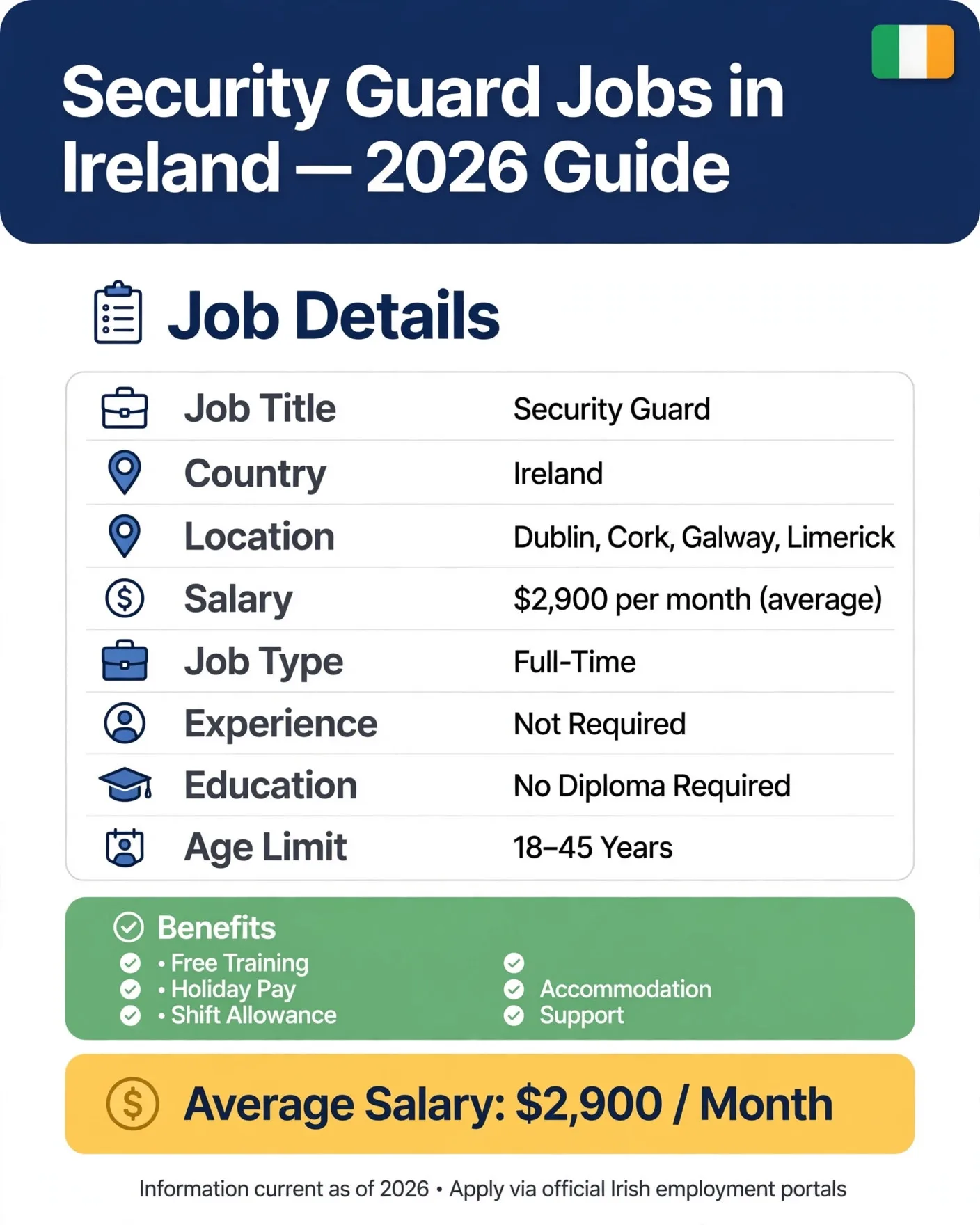
Security guard jobs in Ireland are a steady way to start working without a diploma, and many employers provide training. Your main work is practical and responsible: protect people, buildings and property, check who enters a site, patrol the area, and respond calmly if something goes wrong. Most employers provide a uniform, training and a licence pathway on your first weeks.
You will usually work for a security company, a shopping centre, a hospital, an office building, a warehouse or an event venue. Some guards work alone at a gate or reception, others work in a team on patrol. In job ads this work is also called security officer, static guard, retail security or event security, so read the duties carefully — the job can be very different in a shop, a hospital and a construction site.
Security guard roles in Ireland pay about $2,900 per month on average (about €2,668), with a typical range of $2,300–$3,600 per month depending on the role, shift and location. A Security Officer averages around $2,700 per month, while a Security Supervisor averages around $3,400 per month. The national minimum wage from 1 January 2026 is €13.50 per hour, and a full-time worker is entitled to 20 days of annual leave. In Ireland, security guards normally need a licence from the Private Security Authority (PSA), and many employers help new staff to apply for it.
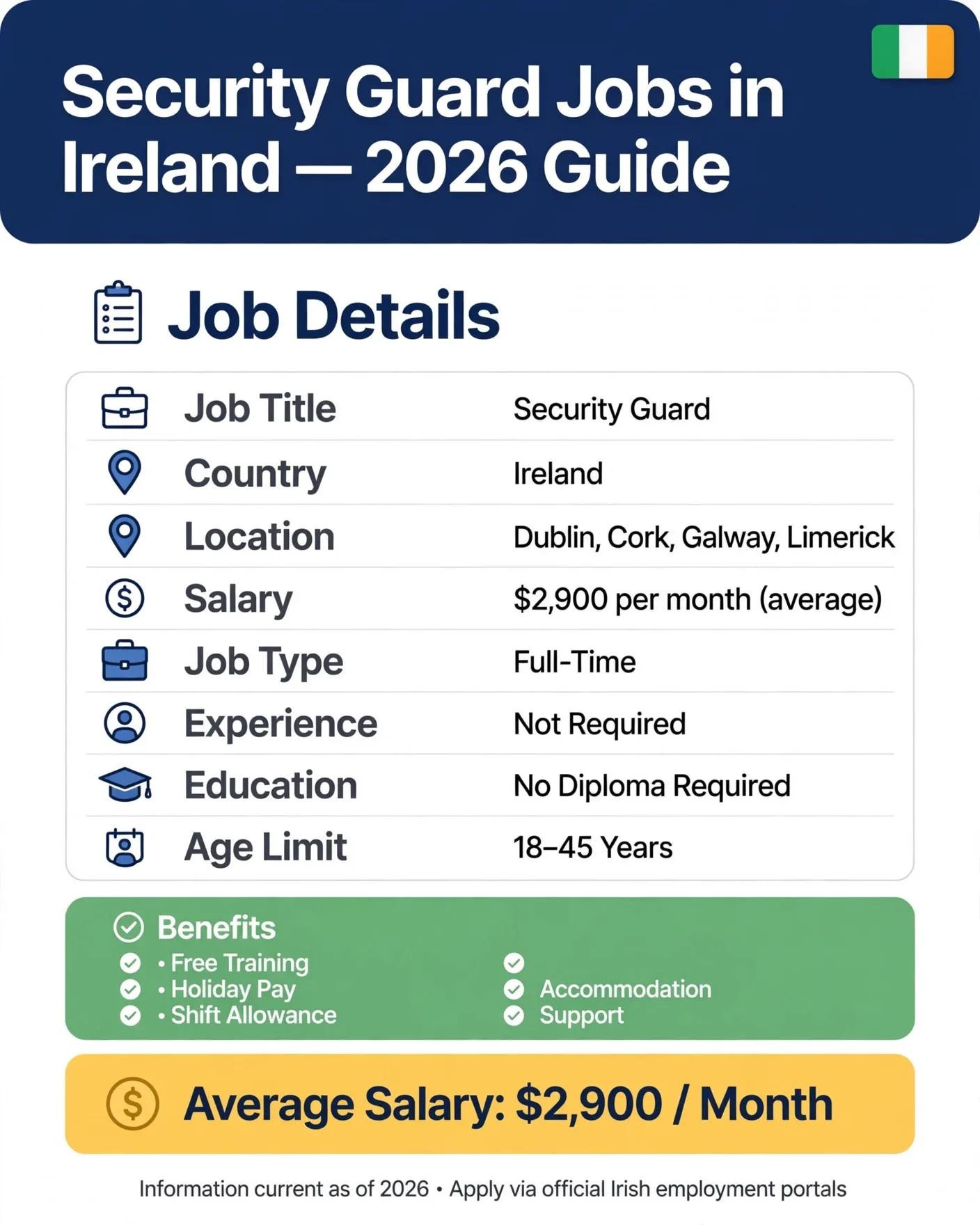
Job Overview
| Job Title | Security Officer / Security Guard |
| Country | Ireland |
| City | Dublin, Cork, Galway, Limerick, Belfast |
| Salary | $2,300–$3,600 per month (average $2,900/mo, about €2,668) |
| Job Type | Full-Time |
| Experience | Not Required — Training Provided |
| Education | No Diploma Required |
| Age Limit | 18–50 Years |
| Application Deadline | 31 December 2026 |
| Work Hours | 39–48 hours per week, day / night / weekend shifts |
| Accommodation | Provided by some employers / agencies (check before you travel) |
| Work Permit | Required for non-EU/EEA applicants; EU/EEA citizens do not need a permit |
Note: Salary figures are averages from job listings. Always confirm the exact salary, hours and benefits in the written job offer before you travel or sign a contract.
What Does a Security Guard Do?
A security guard protects people and property. Your daily tasks depend on the site — in a shop you watch for theft, help customers and check bags when needed; in an office you check IDs at reception, log visitors and patrol corridors; on a construction site you control the gate, check vehicles and patrol the site at night.
Some security jobs are calm and routine, others need quick, calm action when an alarm sounds or a person behaves aggressively. Ask the employer about this before you start, because a job ad does not always show what the work really feels like. You will often stand and walk a lot, work alone at night, and write short reports, so good physical fitness and clear English help. Staying calm, polite and observant matters more than physical strength.
Where to Find Security Guard Jobs in Ireland?
Security work is available across Ireland, but there are more jobs in cities with shops, hospitals and large offices. Dublin has the most retail, office, hospital and event security work. Cork has retail, hospital and industrial security. Galway and Limerick have hospital, university, retail and event security. Belfast has retail, office and event security work.
Do not only look in big cities. Warehouses, factories and care homes in smaller towns also hire security staff. Check the travel time for night shifts — a bus at 9:00 does not help if your shift starts at 22:00. Search with different terms: Security Officer / Security Guard, Static Guard, Retail Security Officer, Event Security, Control Room Operator, Door Supervisor.
What Does a Workday Look Like?
That depends on the site. In a shop you may patrol the floor, watch CCTV, help staff and deal with shoplifters calmly. In an office you may sit at reception, check badges, answer the phone and log deliveries. On a construction site you may check in workers and vehicles, patrol the fence and lock up at night.
There are security jobs with fixed daytime hours, and jobs at night, at weekends and on public holidays. With shift work you may work 12-hour shifts, for example 4 days on and 4 days off. Ask how the roster is made, how many hours you will get each week, and whether night and weekend allowances are paid.
How Much Do Security Guards Earn in Ireland?
Salary varies by employer, experience, licence and shift. In job ads the salary is usually shown per hour or per month, gross — tax and other deductions come off, so the net amount in your bank account is lower. Compare not only the hourly wage but also the number of hours and any allowances. The minimum wage from 1 January 2026 is €13.50 per hour, so a full-time 39-hour week at minimum wage is about €526.50 per week before tax, and many security roles pay above it, especially at night.
For night, weekend and public-holiday work you sometimes get an allowance. It is not the same for every job, and it depends on your agreement and employer. As an employee you also build up paid annual leave — 20 days for a full-time worker — and public holidays. Travel costs are not always paid, so ask from which distance the allowance applies.
Job Responsibilities
- Patrol buildings, grounds and car parks on foot or by vehicle
- Check IDs, log visitors and control access at gates and reception
- Monitor CCTV and alarms and respond to incidents calmly
- Prevent theft, damage and unauthorised entry
- Write short incident and patrol reports
- Help staff, visitors and emergency services when needed
- Follow site rules, health and safety procedures and the PSA code
Requirements
- Age 18 years or older
- No experience required — training is provided on the job
- Able to stand and walk for long periods, including night shifts
- Calm, polite, reliable and able to follow instructions and procedures
- Basic English is enough for most teams; clear spoken English is important for reports
- Valid passport and the right to work in Ireland (or a work permit arranged by the employer)
- A PSA licence is normally required to work as a security guard in Ireland — many employers help new staff to apply, and a clean record is required
Benefits
- Monthly salary of about $2,900 on average, depending on role and shifts
- Paid training, uniform and PSA licence support from many employers
- 20 days paid annual leave plus public holidays
- Night, weekend and public-holiday allowances in many roles
- Overtime opportunities at events and in busy seasons
- Pension contributions from many larger employers
- A clear path to Supervisor, Control Room and Security Manager roles
How to Apply for Security Guard Jobs in Ireland?
- Prepare a short CV — where you worked, which languages you speak, and when you are available.
- Write 2–3 simple sentences, for example: "I am looking for security work near Dublin. I am available for day and night shifts and can start soon. I would like to know more about the site and working hours."
- Apply only through the employer's official website, a known job site such as JobsIreland, or a registered recruitment agency.
- Ask in the interview what type of site it is, whether a PSA licence is provided, and how night shifts are rostered.
- Before your first day, check the address, start time, uniform and the name of your contact person.
Warning: Never pay money to an agent just to get a job. A real employer does not charge a fee for recruitment. Do not send copies of your ID through an unknown chat account. If anyone asks for a fee for a visa, a licence, a job offer or accommodation, stop and check with Citizens Information first.